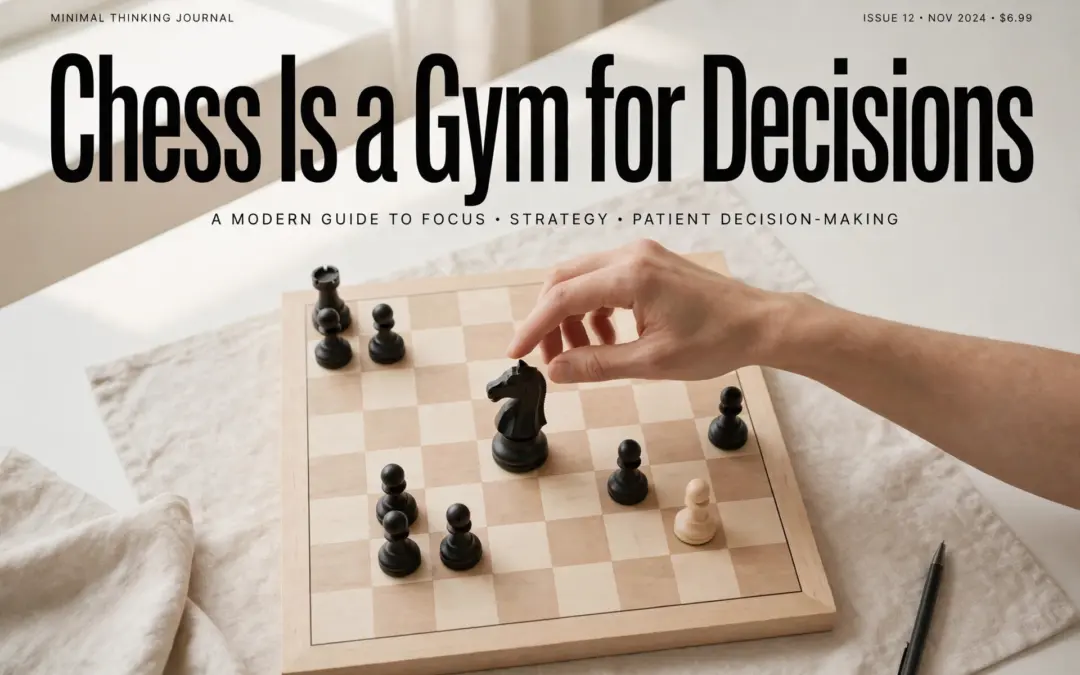
Chess Is a Gym for Decisions: What 64 Squares Teach About Thinking Clearly
Most gyms train muscles you can see. Chess trains one you cannot: the moment between noticing a problem and committing to a move. That moment is visible, timed, and unforgiving. You test an idea against an opponent trying to prove you wrong, choose, and live with the consequences — often within seconds.
That is why chess matters even if you never care about ratings. It is a compact laboratory for thinking clearly, asking the same questions work, money, and relationships ask in messier form: What matters here? What am I missing? What happens if I am wrong? How much time do I have to decide?
The Board Gives Honest Feedback
In ordinary life, bad decisions often hide. Luck can rescue a weak plan, timing can undo a strong one, and it is easy to rewrite the story afterward. Chess is less forgiving, and that is its gift. Overlook a threat, and the punishment usually arrives in the open, where you can study it.
That feedback loop builds habits that transfer:
- Separate the move from the result. A sound decision can still lose from a difficult position; a careless move can win when an opponent misses the reply. Judge the quality of your reasoning, not just the score.
- Name your mistakes precisely. “I played badly” is useless. “I stopped checking what my opponent threatened” is fixable. Specific errors can be trained away; vague disappointment cannot.
- Treat emotion as information, not instruction. Frustration is a signal to slow down, not to lash out. Players chasing revenge usually make the second mistake worse than the first.
Before you move, ask what has changed. After you move, ask what you missed. The learning lives in both questions.
You can start building that loop for free on Chess.com or Lichess, which let you play and review games afterward to see where a position turned.
Calculation vs. Intuition: Two Gears, One Driver
Strong players are often described as either calculators or intuitives. In practice, good thinking uses both gears — and knows when to shift.
Calculation is the deliberate gear: “if I go here, they can go there, then I have this reply.” It is slow and essential when consequences are sharp. Intuition is the fast gear: pattern-based judgment from experience, a sense that a position looks healthy — or quietly wrong — before you can prove it.
Trouble comes from using the wrong gear.
- Calculating everything is paralysis. Work out every possibility and you run out of time and energy. In quiet positions, a sensible move beats an exhausted search for a perfect one.
- Trusting intuition everywhere is recklessness. A move that “feels right” in a sharp position still needs a check. Feelings are a hypothesis, not a conclusion.
- The skill is in the shift. Use intuition to generate candidate moves — the two or three worth examining — then calculate to test them. Intuition proposes; calculation disposes.
Off the board, let experience suggest the shortlist — hiring, planning, choosing projects — then test the finalists: What would have to be true for this to work? What is the strongest argument against it? You need not calculate your whole life, only know which decisions deserve the deep gear.
The Blunder-Check: A Small Habit With Outsized Returns
Ask improving players what changed their results most, and many will name not a brilliant strategy but a pause: before committing, a short blunder-check — a final scan for the obvious disaster they are about to allow.
A useful blunder-check takes only seconds and asks plain questions:
- What is my opponent threatening right now?
- Which of my pieces will be left undefended if I make this move?
- Am I walking into a check, a capture, or a forced reply I have not considered?
- Does this move still make sense if my favourite idea does not work?
The blunder-check needs no brilliance. It catches unforced errors — the dropped piece, the missed threat, the move made while still thinking about the previous one. Most everyday games are not lost to genius, but to one moment of inattention in a playable position.
Life deserves its own version. Before sending the heated message, making the large purchase, or agreeing to the extra commitment, scan: What am I leaving undefended — my time, budget, or attention? What obvious reply have I not considered? What happens if the optimistic version of this plan does not happen?
Most damage does not come from the hard problems. It comes from the easy check nobody ran.
Build the pause into the decision, not after it.
The Clock Teaches Time Management
Chess is one of the few thinking activities where time is literally part of the game. You can find the best move and still lose if finding it consumed your entire clock.
First, time spent should match the importance of the decision. Strong players move quickly in familiar, low-risk positions and invest their minutes at critical moments — when the position is about to change character, or one wrong step is hard to undo. The skill is recognising those moments while there is still time to think.
Second, a good-enough move made in time beats a perfect move that never gets played. Perfectionism on the clock is not high standards; it is a failure to decide. The report sent Tuesday usually matters more than the flawless version still being polished Friday.
Third, time trouble compounds errors. Players left with seconds start blundering, not because they know less, but because pressure without margin destroys judgment. So protect a reserve: a buffer for the endgame, unscheduled hours in a working day, budget held back from a plan’s first draft. Margin is not waste. It is what lets you think when the position gets complicated.
Pattern Libraries: Why Experience Starts to Look Like Talent
Watch an experienced player glance at a position and suggest a sensible plan, and it can look like magic. It is mostly memory — not of facts, but of shapes. Over hundreds of games, players build a pattern library: typical pawn structures, common tactical motifs, and familiar endgames where the correct plan is known in advance.
Pattern libraries change decision-making in three ways:
- They shrink the search. You recognise the type of situation and start with the moves that usually belong there.
- They flag anomalies. When a familiar pattern has one unusual feature, it stands out — and differences are often where the real decision lives.
- They free up attention. Energy saved on routine parts can be spent on the part that is genuinely new.
You already build such libraries in your own field: the manager who has seen a project wobble in a familiar way, or the parent who recognises the start of a tired meltdown, is reading shapes, not just facts. Chess makes the process deliberate. Reviewing games and solving puzzles — available on Chess.com and Lichess — is pattern training in its purest form.
The caution matters too. Patterns are shortcuts, and shortcuts mislead. A position resembling a familiar one may demand the opposite plan. Use patterns for your first hypothesis, then let the specific facts have the final word.
A Small Training Plan for Clearer Thinking
You do not need to become a serious player. A modest, regular practice is enough:
- Play a few games a week at a time control that lets you think. Longer games teach calculation, patience, and clock discipline far better than very fast ones.
- Review one loss without excuses. Find where the position genuinely turned and write down what you failed to check. One honest sentence per game compounds quickly.
- Solve a handful of puzzles regularly. Short tactical exercises on Chess.com or Lichess sharpen the habit of looking for what an opponent can do to you.
- Practise the pause. For one session, run your blunder-check before every move, then borrow that pause for decisions away from the board.
Chess will not make your decisions for you. What it offers is rarer: a place to practise deciding — under pressure, against resistance, with honest feedback — where a mistake costs only a game. Train there, and clearer thinking follows you off the board.