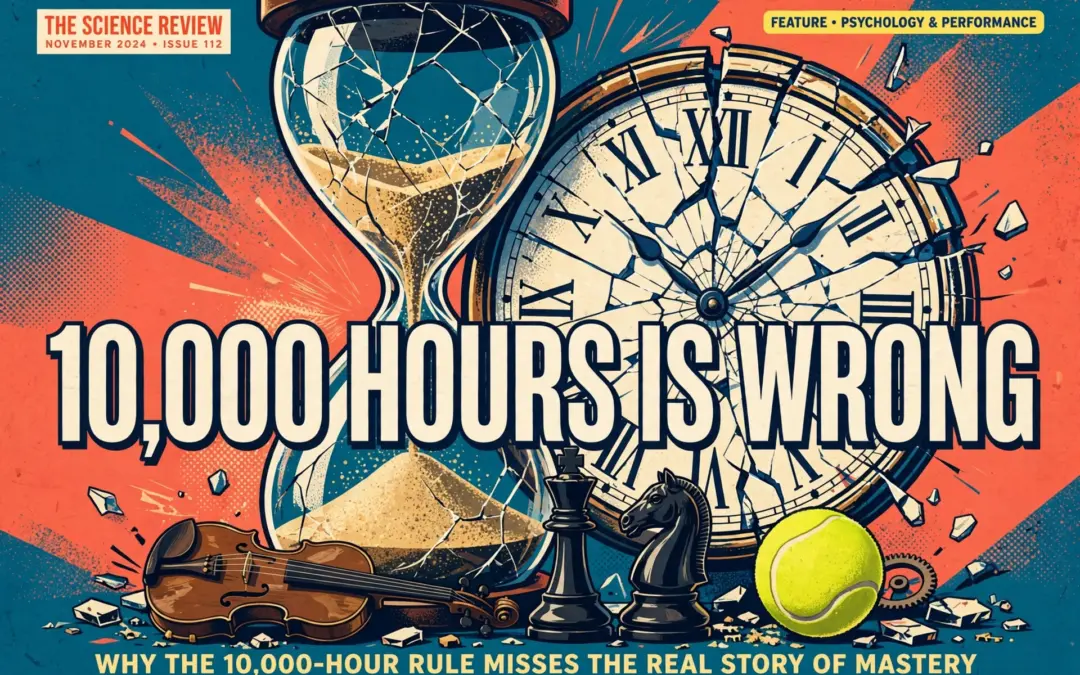
You’ve heard the rule. Put in 10,000 hours of practice at anything — violin, chess, coding, golf — and you’ll arrive at expertise. It’s one of the most repeated ideas in self-improvement, and it’s wrong in almost every way that matters. Not because practice doesn’t work. It does. But the number is a myth, the hours were never the point, and the researcher whose work the rule is based on spent years saying so.
Here’s the small bit worth keeping: it’s not how long you practice. It’s what the practice is doing to you while you do it.
Where the Rule Came From
The 10,000-hour rule was popularized by Malcolm Gladwell in his 2008 book Outliers, drawing on research by psychologist Anders Ericsson and his colleagues, who had studied violin students at a Berlin music academy in the early 1990s. Gladwell distilled their work into a memorable formula, writing: “Practice isn’t the thing you do once you’re good. It’s the thing you do that makes you good.”
It’s a great line, and the formula is catchy. There’s just one problem: Ericsson himself objected to it, repeatedly and in print. In his own book, Peak: Secrets from the New Science of Expertise, written with Robert Pool, he set out what his research actually showed — and it looks quite different from the rule that made him famous.
What Ericsson Actually Found
Ericsson’s central finding was never about a number of hours. It was about a kind of practice, which he called deliberate practice, and it has specific ingredients:
- It’s designed to improve a specific aspect of performance — not the whole skill at once, but a targeted weakness, broken into parts small enough to work on.
- It happens at the edge of your current ability — just beyond what you can already do comfortably. Comfort, in this model, is the enemy; if practice feels easy, it probably isn’t changing anything.
- It comes with immediate, informative feedback — you learn right away whether the attempt worked, so errors get corrected instead of rehearsed.
- It usually involves a teacher or coach — someone who knows what excellence in the field looks like and can design the next step.
- It works best in domains with stable rules and established training methods — fields like music, chess, and competitive sports, where “better” is well defined and experts agree on how to get there.
Notice what’s missing from that list: a stopwatch. Ericsson’s point was that most of what people call practice — playing songs you already know, running drills you mastered years ago, logging hours at a job you’ve plateaued in — doesn’t qualify. He drew a sharp line between naive practice (repetition) and deliberate practice (structured, feedback-driven effort aimed at your current limits). One fills time. The other builds skill.
“The right sort of practice carried out over a sufficient period of time leads to improvement. Nothing else.” — Anders Ericsson and Robert Pool, Peak (2016)
The Number Was an Average, Not a Finish Line
So where did 10,000 come from? In the Berlin violin study, the best group of students had accumulated, on average, roughly 10,000 hours of practice by the age of twenty. An average is a description of a group, not a threshold for an individual — some of those top students had practiced considerably less, others more. And the students were twenty: highly accomplished, yes, but not yet the finished masters the rule implies. Ericsson pointed out that in many fields, the people who reach the very top keep accumulating far more than 10,000 hours well into their careers.
Turning an average into a magic number also hides the most important variable: those hours were hours of deliberate practice, accumulated under teachers, in a structured academy environment. Ten thousand hours of casual repetition is a completely different thing — as anyone who has played the same three guitar chords for twenty years can confirm.
Then the Meta-Analysis Complicated Things Further
Even deliberate practice, it turns out, isn’t the whole story. A widely reported 2014 meta-analysis in Psychological Science by Brooke Macnamara, David Hambrick, and Frederick Oswald pooled the available research and asked how much of the difference between performers deliberate practice actually explains. Their reported findings: about 26% of the variance in games, 21% in music, 18% in sports, 4% in education, and less than 1% in professions (the study’s abstract is available via PubMed).
Read that carefully. Deliberate practice matters — in games and music it accounts for a real, substantial share. But the majority of the gap between good and great comes from other things: starting age, working memory and other cognitive abilities, the quality of instruction, opportunity, and factors researchers are still sorting out. Ericsson disputed aspects of the meta-analysis — particularly how loosely some included studies defined “deliberate practice” — and the debate is genuine. But no serious reading of the evidence supports “hours in, mastery out.”
The pattern in the numbers is itself a clue. Deliberate practice explains the most in domains with stable rules, clear feedback, and objective scoring — chess, music performance, sports. It explains the least in professions, where the rules shift, feedback is muddy, and nobody agrees exactly on what “best” looks like. The less stable the domain, the less a practice formula can carry you.
The Practical Bit: Practice Like It Matters
So what do you do with all this, if you’re trying to get better at something real? The research, stripped of the myth, gives a workable recipe:
- Shrink the target. Don’t “practice piano.” Practice the four bars you keep fumbling, at a tempo where you can get them right. Specific beats general.
- Work at the edge. Deliberately choose tasks slightly beyond your current level. Struggle is a signal you’re in the right zone — smooth sailing is a signal you’re not.
- Close the feedback loop. Record yourself, test yourself, measure the output, get a coach or a sharp-eyed peer. Feedback you get next month is archaeology; feedback you get now is instruction.
- Count quality reps, not hours. A focused hour with feedback will outperform a distracted afternoon. Ericsson’s expert performers typically practiced deliberately in relatively short, intense sessions — and rested seriously in between.
- Protect rest and sleep. Consolidation is part of learning, not a break from it. Exhausted practice encodes sloppy patterns.
- Pick your domain honestly. In stable-rule fields, structured practice is close to a superpower. In messy, shifting fields, it still helps — but judgment, positioning, and adaptability carry more of the load, and your practice should train those too.
The Big Idea
The 10,000-hour rule survives because it’s simple, flattering, and easy to sell: greatness as a savings account, mastery as a balance you reach. The actual research is less tidy and more useful. There is no magic number. There is a method — targeted, uncomfortable, feedback-rich practice — and even that explains only part of the gap between performers.
Which is oddly good news. If hours were all that mattered, the only lever you’d have is time, and time is the one resource you can’t make more of. But if the quality of practice is the lever — the targets you choose, the feedback you build, the edge you work at — then improvement is a design problem, and design problems can be solved. Stop counting hours. Start engineering reps.