Would You Rather Be a Master of One… or Good at Everything?
You’ve heard the phrase before:
“Jack of all trades, master of none.”
It’s usually said as a warning—pick one path, specialize, go deep… or risk being average forever.
But the full quote tells a very different story:
“Jack of all trades, master of none, though oftentimes better than master of one.”
That second half changes everything.
So now the real question becomes:
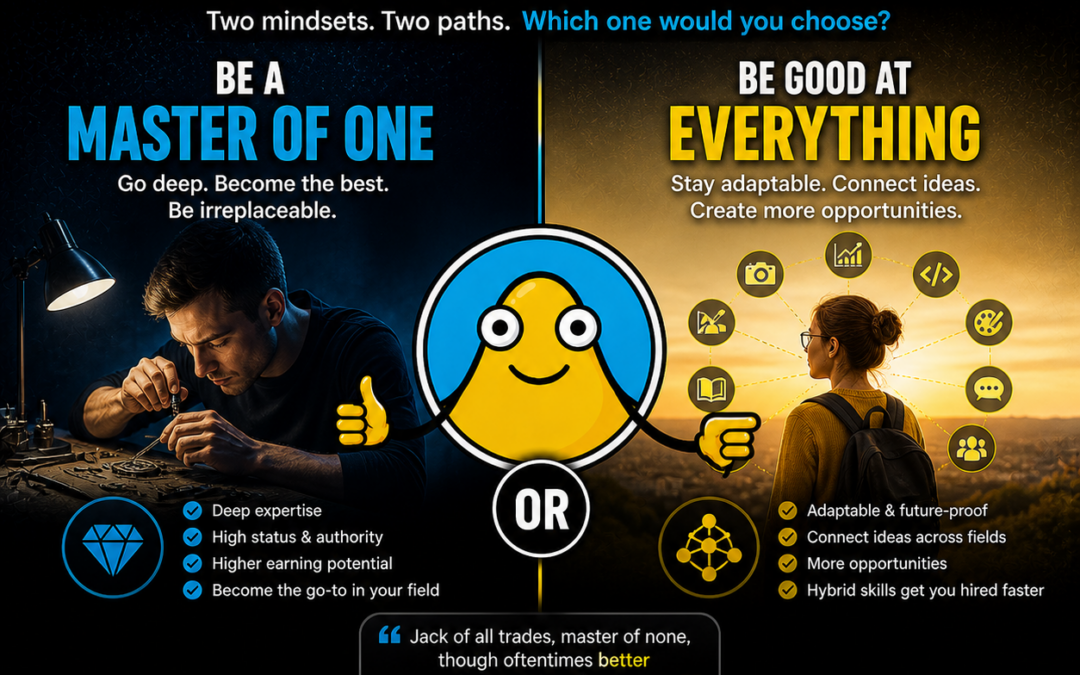
Would you rather be a master of one skill… or good at everything?
This isn’t just a philosophical debate. It’s one of the most important decisions shaping careers, income, identity—and even happiness—in the modern world.
The Case for Mastery: Depth Wins
There’s a reason specialization has been the dominant strategy for decades.
In fields like medicine, law, engineering, and elite sports, depth creates dominance.
- A neurosurgeon doesn’t dabble—they go all in
- A top tennis player doesn’t split focus—they obsess over one craft
- A world-class programmer doesn’t casually code—they master systems
Why it works:
- You become irreplaceable
- You command higher pay
- You build authority and reputation
📊 The Data
- According to the U.S. Bureau of Labor Statistics, specialized roles consistently earn higher median salaries than general roles
- A McKinsey report found that deep expertise is still one of the top predictors of leadership in technical fields
💬 Quote
“You can’t fake depth.” — Naval Ravikant
Mastery creates a moat. It separates you from the crowd.
The Case for Versatility: Adaptability Wins
But here’s where things get interesting.
The world has changed.
Careers are no longer linear. Industries evolve fast. Skills expire.
And suddenly, being only great at one thing… can become a liability.
📊 The Data
- The World Economic Forum estimates that 44% of workers’ core skills will change within 5 years
- LinkedIn reports that the most in-demand professionals have hybrid skill sets, not single-track expertise
- A Harvard Business Review study found that generalists are more likely to be promoted into leadership roles due to broader perspective
Why versatility matters now:
- You can pivot when industries shift
- You connect ideas across fields (this is where innovation happens)
- You’re more resilient in uncertain environments
💬 Quote
“In a world that’s changing quickly, the biggest risk you can take is not taking any risk.” — Mark Zuckerberg
Generalists don’t just survive change—they ride it.
The Real Winners: The “Hybrid Thinkers”
Here’s the truth most people miss:
It’s not actually master vs generalist.
The people who win today are something in between.
They’re often called “T-shaped” individuals:
- Deep expertise in one area (the vertical line)
- Broad knowledge across many areas (the horizontal line)
Examples
1. Elon Musk
Not the world’s best engineer in every field—but understands physics, software, manufacturing, and business deeply enough to connect them.
2. Steve Jobs
Not a programmer—but combined design, technology, and human psychology into revolutionary products.
3. Modern Entrepreneurs
Today’s founders often blend:
- Marketing
- Product design
- Data analysis
- Psychology
They don’t just specialize—they integrate.
The Psychology Behind the Choice
Why is this question so hard?
Because it taps into identity.
- Specialists often tie their identity to being the best
- Generalists tie their identity to being adaptable and free
Social Comparison Effect
We constantly measure ourselves against others:
- The specialist sees the generalist as scattered
- The generalist sees the specialist as limited
Both perspectives are incomplete.
The Hidden Trade-Offs
If You Choose Mastery:
✅ High status
✅ Deep expertise
❌ Risk of obsolescence
❌ Less flexibility
If You Choose Versatility:
✅ Adaptability
✅ Broader opportunities
❌ Risk of being “average”
❌ Harder to stand out
The Modern Reality: The Rules Have Changed
In the past, mastery alone could carry you for life.
Today?
- AI is replacing narrow skill sets
- Automation is reshaping industries
- Knowledge is more accessible than ever
The edge is no longer just what you know—
It’s how many domains you can connect.
💬 Quote
“The future belongs to people who learn faster than the world changes.” — Eric Hoffer
So… What Should You Choose?
Here’s the honest answer:
Start broad. Then go deep. Then expand again.
Think in phases:
- Explore widely → discover strengths
- Go deep in one area → build leverage
- Expand across fields → multiply opportunities
This is how modern careers actually evolve.
The Normie Question
At the end of the day, this isn’t just about careers.
It’s about how you see yourself.
Would you rather be known for one thing… or capable of many?
There’s no perfect answer.
But your choice will shape:
- How you learn
- How you work
- How you grow
Final Thought
The quote wasn’t meant to limit you.
It was meant to challenge you.
“Jack of all trades, master of none… though oftentimes better than master of one.”
Maybe the goal isn’t to pick a side.
Maybe the goal is to become something new entirely.
👉 Normie
Would you rather be a master of one… or good at everything?
Vote now on Normie and see how your answer compares to everyone else.
Stop guessing where you stand—see it.
👉 Head to Normie and answer the question:
Would you rather be a master of one… or good at everything?
In seconds, you’ll see how thousands of people think—
where you align… and where you don’t.
Compare your mindset.
Challenge your assumptions.
Discover what’s actually normal.
Vote now on Normie and see how you compare.