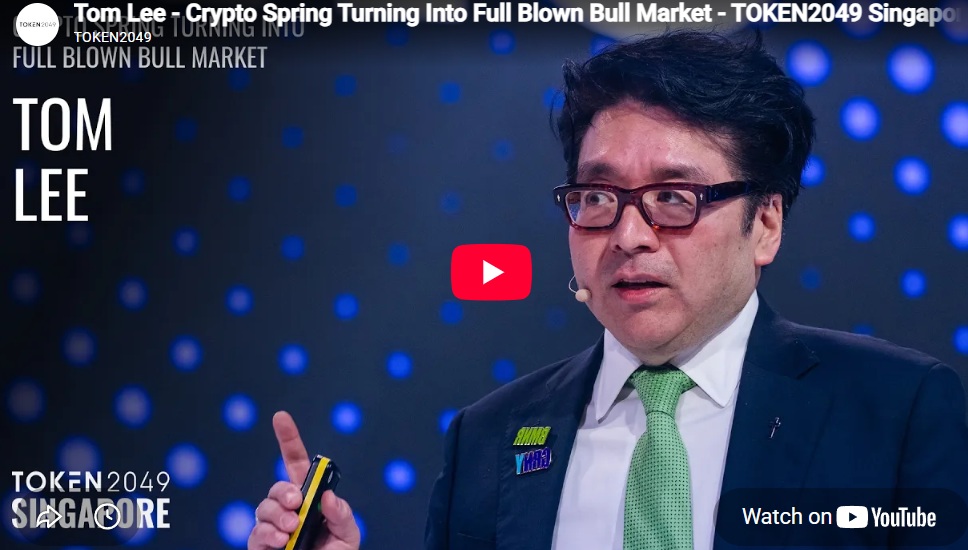
Tom Lee’s Next Crypto Bull Market Thesis: Tokenization, AI, and a Changing Financial System
At TOKEN2049, Lee argued that crypto’s next expansion could draw strength from forces that barely existed in earlier cycles.
Tom Lee believes crypto has entered a new bull market—and that its biggest drivers could extend far beyond retail speculation.
In his TOKEN2049 Singapore 2026 presentation, recorded October 7, the BitMine chairman and Fundstrat investment strategist outlined an optimistic case built around institutional tokenization, generational wealth transfers, corporate crypto treasuries, and AI-powered payments.
His central argument is that these forces could reinforce one another, bringing new demand to blockchain networks while changing how people access digital assets.
It is an ambitious thesis. Understanding it requires separating the structural developments Lee describes from his much more speculative conclusions about prices.
Tom Lee – Crypto Spring Turning Into Full Blown Bull Market – TOKEN2049 Singapore 2026
Why Lee Thinks a Bull Market Has Begun
Lee opens with several signals he interprets as evidence of a market turn: institutional interest, technical indicators, ETF inflows, and crypto’s performance despite difficult financial conditions.
He cites Bitcoin’s position relative to its 200-day moving average and an Ethereum golden cross as supporting evidence.
A 200-day moving average helps describe a longer-term price trend. A golden cross generally occurs when a shorter-term moving average rises above a longer-term one.
Such indicators can strengthen a market interpretation, but they cannot confirm what happens next. Their usefulness depends on the period examined, the precise rules applied, and the broader environment.
Likewise, positive fund flows can indicate demand without proving that a sustained bull market has begun.
Lee’s opening is best understood as a collection of signals supporting his outlook, rather than mathematical proof of a future rally.
1. Tokenization Could Bring Blockchain Into Mainstream Finance
The first pillar of Lee’s thesis is institutional tokenization.
Earlier crypto cycles drew substantial attention from retail activity, including token launches and digital collectibles. Lee expects a larger role for financial institutions seeking to represent assets and transactions on blockchain infrastructure.
Tokenization can involve funds, securities, commodities, and other financial claims. Its potential appeal includes programmable transactions, different distribution models, and changes to settlement processes.
Lee identifies Ethereum as a major potential beneficiary.
The important distinction is between assets moving onto blockchain infrastructure and money flowing into a blockchain’s native token.
Those are related possibilities, but they are not interchangeable.
A tokenized fund can grow without requiring investors to hold a proportionate amount of ETH. The economic effect depends on network usage, fees, settlement design, and where activity occurs.
Tokenization’s potential scale makes it worth watching. The mechanism connecting that activity to token value still matters.
2. Inherited Wealth Could Change Investment Preferences
Lee’s second pillar is the transfer of wealth between generations.
He argues that younger beneficiaries could allocate inherited assets differently, potentially directing more capital toward equities and crypto.
This is a behavioral thesis as much as a demographic one.
An inheritance creates an allocation decision. It does not predetermine the answer. Recipients may buy property, repay debt, preserve existing portfolios, or spend the money.
Nevertheless, the question is significant: how might investment preferences change as financial assets pass to people with different experiences of technology and digital ownership?
For crypto, the opportunity would depend on whether that familiarity translates into sustained allocations.
3. Corporate Crypto Treasuries Could Reshape Demand
The third pillar is the growth of digital asset treasury companies: businesses that hold substantial crypto assets on their balance sheets.
Lee argues that these companies can become important buyers and reduce the supply readily available for trading.
That can support prices when demand strengthens. But treasury-company activity can also introduce complications.
A company’s capacity to accumulate crypto depends on financing conditions, its share price, and investors’ willingness to supply capital. A treasury stock can trade above or below the value of its underlying holdings.
Consequently, owning the stock differs from owning the cryptocurrency directly.
Shareholders are exposed to management decisions, operating costs, financing obligations, and changes in the market’s valuation of the corporate structure.
Treasury companies may provide a significant source of demand. Their future purchases should not be treated as automatic.
4. AI Agents Could Create New Payment Activity
Lee’s fourth pillar connects crypto to artificial intelligence.
His argument is that autonomous software will need ways to pay for services, acquire computing resources, and transact with other systems.
Crypto wallets, stablecoins, and smart contracts could support parts of that activity.
Consider an agent authorized to purchase access to a dataset or pay for a completed computing task. Programmable payments could help coordinate the exchange, subject to spending limits and verification.
The adoption question remains open. Agents could also use conventional payment providers, bank infrastructure, or platform credits.
And even substantial adoption of blockchain payments would not guarantee equivalent gains across crypto assets. Different networks, applications, and payment providers would capture different parts of the activity.
The structural opportunity is machine-driven commerce. Identifying its economic beneficiaries requires a more specific analysis.
Why Lee Places Ethereum at the Center
Ethereum connects several parts of Lee’s presentation: tokenized finance, programmable transactions, treasury accumulation, and staking.
He presents these as mutually reinforcing sources of potential demand.
He also offers very aggressive ETH price scenarios and corresponding projections for BitMine’s shares. Those projections are expressions of his investment thesis, not established outcomes.
His position matters here: Lee is discussing a company he chairs and a strategy centered on Ethereum exposure.
Readers should therefore distinguish his broad argument about blockchain adoption from his promotion of a particular corporate vehicle.
A treasury stock’s relationship with ETH can change as its share count, liabilities, holdings, and valuation change. It cannot be assumed to follow a fixed price conversion.
Adoption and Investment Returns Are Different Questions
The presentation’s strongest contribution is its attempt to connect several developments into one larger story.
Institutions could expand tokenization. New generations could alter portfolio preferences. Corporate treasuries could influence demand. AI agents could introduce new transaction activity.
These possibilities deserve attention individually and together.
But adoption alone does not determine an asset’s return. Starting valuation, competition, financial conditions, and the distribution of economic benefits all affect the outcome.
A persuasive market thesis needs both a reason for activity to grow and an explanation of how the asset captures value from that growth.
The Question to Carry Forward
Lee’s presentation makes a forceful case that crypto could become more deeply integrated into finance and software.
His price forecasts require much stronger assumptions than that structural observation alone.
The useful question for readers is therefore specific: which developments are becoming measurable, and how do they affect the networks, assets, and companies involved?
That approach gives the bullish thesis something concrete to prove.

Tom Lee’s Bull Case Deserves Attention—and Better Questions
Why the next crypto cycle needs research, context, and a clearer understanding of what actually captures value.
Tom Lee’s TOKEN2049 presentation offers a compelling way to think about crypto’s potential next chapter.
His argument connects institutional tokenization, generational wealth transfers, digital asset treasuries, and AI payments. These are substantial ideas, and their interaction could matter more than any single chart signal.
What interests me most is the possibility that crypto becomes infrastructure people use through financial products and software, sometimes without thinking about the blockchain underneath.
Where I become more cautious is the jump from that possibility to enormous price targets.
A growing tokenized asset market does not tell us exactly how much value ETH captures. More AI payments do not establish which network wins. A company holding cryptocurrency does not automatically outperform that cryptocurrency.
Those connections need evidence.
That is where a resource like Crypto Turf fits into the conversation. The site brings together crypto news and analysis, market information, learning guides, tools, and coverage of memecoins, AI, and Web3.
For readers unpacking Lee’s thesis, its learning hub provides a starting point for understanding the underlying concepts. Its tools section offers calculators for examining assumptions, while its news and analysis section provides further market reading.
The value of that kind of resource is helping readers ask sharper questions:
What activity is growing? Who pays for it? Which asset benefits? What would weaken the thesis?
My reaction to Lee’s presentation is constructive curiosity. The structural argument deserves investigation, while the forecasts deserve scrutiny.
A compelling narrative starts the research. Evidence determines whether it holds up.